
|
Getting your Trinity Audio player ready...
|
This report provides a formal analysis of the criminal profile, behavioral patterns, and investigative challenges associated with the unidentified serial killer known as the Zodiac Killer.
The Zodiac Killer is perhaps the most elusive unidentified serial murderer in American history. Operating in Northern California during the late 1960s, the killer taunted police and the public with cryptic letters, blood-stained evidence, and complex ciphers, some of which took decades to crack.
Offender Overview
- Name: Unidentified
- Aliases: Zodiac Killer, The Zodiac
- Active Period: Primarily 1968–1969, with communications extending to 1974.
- Location: Northern California (Vallejo, Benicia, Napa County, and San Francisco).
- Criminal Status: Case remains open and unsolved by law enforcement agencies (Vallejo Police Department, Napa County Sheriff’s Office, Solano County Sheriff’s Office, and the FBI).
- Victim Count: Confirmed: 5 killed, 2 wounded. Claimed: 37 victims.
Criminal History and Timeline
The Zodiac Killer’s known criminal acts were a series of public attacks on young couples and a lone cab driver, escalating rapidly in violence and public visibility.
| Date | Location | Victims | Method of Crime |
| Dec 20, 1968 | Lake Herman Road, Benicia | David Faraday (17) & Betty Lou Jensen (16) | Both shot (Faraday once, Jensen five times). Both killed. |
| July 4, 1969 | Blue Rock Springs Park, Vallejo | Darlene Ferrin (22) & Mike Mageau (19) | Shot at close range. Ferrin killed; Mageau survived. |
| Sept 27, 1969 | Lake Berryessa, Napa | Bryan Hartnell (20) & Cecelia Shepard (22) | Stabbed repeatedly while tied up. Shepard killed; Hartnell survived. |
| Oct 11, 1969 | Presidio Heights, San Francisco | Paul Stine (29), Cab Driver | Shot in the head. Killed. |
Investigation and Legacy
Despite thousands of suspects—most notably Arthur Leigh Allen, who was heavily investigated by the Vallejo Police Department—no one was ever charged. The case remains open in several jurisdictions.
| Key Evidence | Description |
| Ballistics | 9mm and .22 caliber weapons used. |
| Handwriting | Characteristic “Celtic Cross” symbol used as a signature. |
| Fingerprints | A partial bloody print was recovered from Paul Stine’s taxi. |
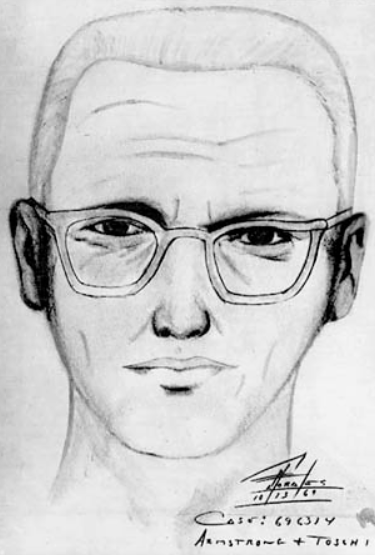
| Descriptions | Described as a white male, 5’8″ to 6’0″, stocky build, wearing glasses. |
Modus Operandi (MO) and Signature
Modus Operandi (MO)
The killer’s MO evolved from random, opportunistic attacks to a highly theatrical and planned murder:
- Targeting: Initial attacks targeted young couples in secluded “lover’s lane” areas. The final confirmed victim was a lone cab driver, suggesting a shift to more easily accessible urban targets.
- Luring/Approach: In the first two attacks, he boxed in the victims’ cars. At Lake Berryessa, he wore a hooded executioner’s costume bearing his crosshair symbol and presented himself as an authority figure, claiming to be escaping from a prison.
- Weapons: Used different weapons for each confirmed event. 22-caliber pistol, 9mm pistol, and a knife. The final victim was killed with a 9mm pistol.
Signature
The Zodiac’s primary signature was his communication with the public and press:
- Taunting Letters: He sent numerous letters to Bay Area newspapers (San Francisco Chronicle, Vallejo Times-Herald, and San Francisco Examiner) detailing his crimes to prove authenticity and threatening to commit more if the letters were not published.
- The Symbol: He signed all correspondence with a distinct symbol: a circle with a crosshair through it, resembling a scope or the Zodiac wheel.
- Ciphers (Cryptograms): He sent four cryptograms (Z408, Z340, Z13, and Z32), two of which have been publicly solved (Z408 and Z340). The contents often detailed his motivation (collecting slaves for the afterlife) and mocked law enforcement.
Psychological and Behavioral Profile
The Zodiac Killer fits the profile of an Organized, Process-Focused, Missionary/Power-Assertive serial killer.
- Motivation: His decoded letters suggest a belief that he was collecting “slaves” for the afterlife, placing him in the missionary category, while his taunting communication suggests a strong desire for power and media attention.
- Intelligence: His complex ciphers (especially the Z340, which took over 50 years to solve) suggest an above-average to high level of intelligence and an interest in cryptography or codes.
- Fantasy Life: The elaborate costume at Lake Berryessa indicates a detailed, theatrical fantasy life that dictated the specific performance of the crime.
- Local Knowledge: His choice of remote, local “lover’s lane” locations suggests a deep familiarity with the geography of Solano, Napa, and San Francisco counties.
Investigative Challenges
The case remains unsolved due to several critical factors:
- DNA Evidence: While DNA exists, it is degraded, partial, or contaminated, making it unsuitable for modern investigative genetic genealogy (IGG) without further breakthroughs.
- Lack of Confession/Direct Evidence: No direct link, confession, or sufficient physical evidence has ever conclusively named a suspect.
- Misinformation and Hoaxes: The killer’s communications spurred a wave of copycats and hoax letters, complicating the authenticity of the paper trail after 1970.
Note for Researchers:
The geographic “cluster” of the crimes suggests the killer had a deep familiarity with the Vallejo and San Francisco areas, likely traveling by car between the suburbs and the city.

