

|
Getting your Trinity Audio player ready...
|
Executive Summary
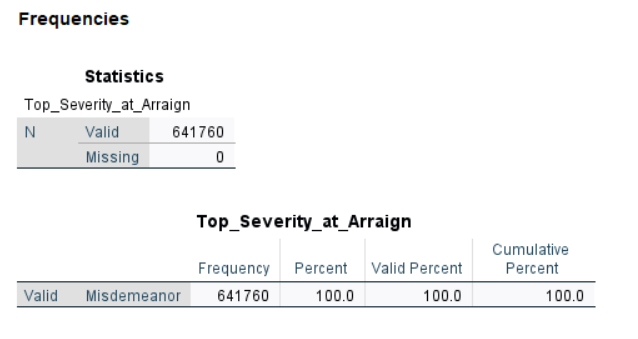
This analysis examines pretrial release outcomes across different racial groups within the New York Unified Court System Pretrial Release Data, covering cases filed from January 2022 through June 2024. To ensure a fair comparison, the study isolated misdemeanor offenses (N = 641,760), effectively controlling for the severity of the top charge. The findings indicate a statistically significant disparity in Release on Recognizance (ROR) rates, suggesting that racial disparities in the justice system persist even in low-level offense categories.
Methodology
The analysis was conducted using SPSS as part of advanced research for the Master of Science in Criminal Justice (MSCJ) program at Boston University’s Metropolitan College.
- Data Source: New York Unified Court System Pretrial Release Data (January 2022 – June 2024).
- Variable Control: A filter was applied to the dataset—Top_Severity_at_Arraign = “Misdemeanor”—to ensure all cases represented the same level of legal seriousness.
- Statistical Procedure: A bivariate crosstabulation and Pearson Chi-Square test were utilized to analyze the relationship between Race and Pretrial_Outcome.
Key Findings
The study focused on Release on Recognizance (ROR), where a defendant is released by the court without a financial requirement.
| Demographic Group | ROR Rate (%) | Total Valid Cases (N) |
| White | 75.9% | 169,018 |
| Black | 73.4% | 191,730 |
| Overall Total | 77.5% | 465,232 |
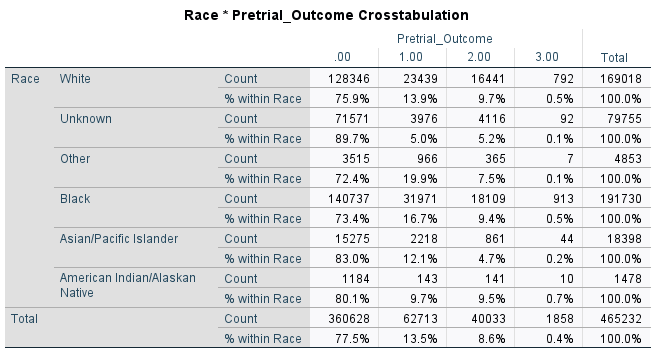
- Observed Disparity: Even when restricted to misdemeanors, White defendants were released on their own recognizance at a rate 2.5 percentage points higher than Black defendants.
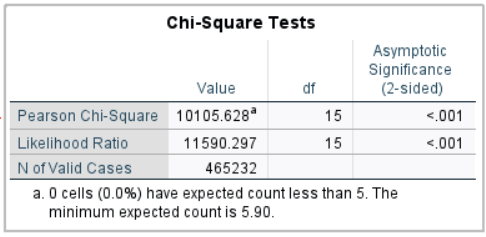
- Statistical Significance: The Pearson Chi-Square test returned a value of 10105.628 (p < .001). This confirms that the disparity is not due to random chance and is highly significant within the criminal justice system.
Discussion & Analysis
The removal of felony cases from the sample is a critical step in this research. While the gap in ROR rates for misdemeanors (2.5%) is narrower than the gap found in the total case population, its persistence suggests that factors beyond the immediate “top charge” are influencing judicial release decisions. These factors may include prior criminal history, socio-economic variables, or implicit biases present during the arraignment stage.
Technical Documentation Notes
- Data Quality: 27.5% of cases (N = 176,528) were excluded due to missing race or outcome data, leaving a valid sample of 465,232 cases.
- Academic Application: These findings serve as foundational data for broader sociological and criminal justice research into systemic inequities within pretrial proceedings.

