
|
Getting your Trinity Audio player ready...
|
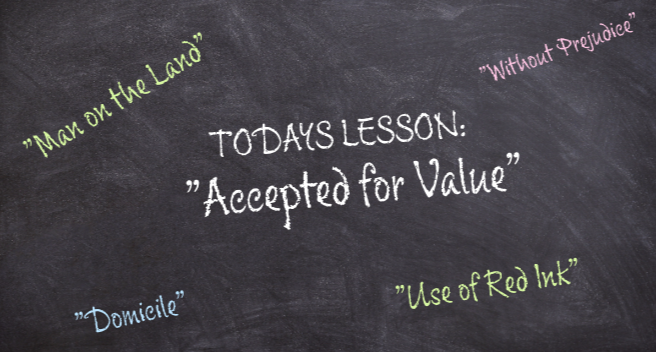
Sovereign citizens often use the phrase “Accepted for Value” (A4V) in a distorted way, believing it grants them some kind of legal advantage. Here’s a breakdown of the misuse and what it actually means:
Sovereign Citizen Belief:
- Sovereign citizens believe writing “Accepted for Value” on documents, particularly invoices or debt collection notices, magically negates their obligation to pay.
- In their view, it forces the creditor to prove the debt is valid and enter into a new commercial agreement before collection efforts can proceed.
Reality of “Accepted for Value”:
- The concept of “Accepted for Value” has a legitimate meaning in commercial law, but not in the way sovereign citizens use it.
- Generally, it applies to negotiable instruments like checks or bills of exchange. It signifies that the receiver acknowledges the instrument and agrees to be bound by its terms.
Why Sovereign Citizens Are Wrong:
- Misunderstanding Commercial Law: “Accepted for Value” is a genuine legal term used in commercial transactions involving negotiable instruments like checks or bills of exchange [1, 2]. It signifies that someone has received something of value (like goods or services) in exchange for accepting the negotiable instrument.
- Fabricated Debt Elimination: Sovereign citizens often misuse this phrase to create pseudo-legal documents they claim negate their debts. They might write “Accepted for Value” on nonsensical financial instruments or invoices, believing it cancels out legitimate debt [2, 3]. This concept has no legal basis.
- Strawman Theory Connection: The misuse of “Accepted for Value” sometimes connects to the “strawman” theory. Sovereign citizens believe their legal name is a separate entity and use the phrase to argue this entity has “accepted” something of value, not them personally [3]. This theory holds no weight in courts.
- False Challenge to Creditor Rights: They might use this phrase on documents they send to creditors, hoping to manipulate the system and cast doubt on the validity of the debt [2]. Courts recognize these tactics and focus on the actual debt and legal agreements.
What “Accepted for Value” Really Means:
- In legitimate contexts, “Accepted for Value” is used when someone accepts a negotiable instrument, like a check, in good faith and assumes the risk that the issuer has sufficient funds to cover it.
Here’s what to remember:
- Sovereign citizen use of “Accepted for Value” is a misunderstanding of commercial law.
- It doesn’t erase debts or require a new contract.
- If you encounter someone using AFV in this way, it’s likely a sign of sovereign citizen ideology and potential resistance to legal obligations
Citations:
[1] Cornell University Law School: Legal Information Institute: Negotiable Instruments [https://www.law.cornell.edu/ucc/3/3-104]
[2] Anti-Defamation League: The Sovereign Citizen Movement [https://www.adl.org/resources/backgrounder/sovereign-citizen-movement-united-states]
[3] Tennessee Administrative Office of the Courts: Sovereign Citizen Use of Documents [https://www.tn.gov/content/dam/tn/attorneygeneral/documents/pr/2022/pr22-23-order.pdf]

